The Comic Foil, the Straight Man and the Job of Contrast
Learn how a comic foil makes eccentric behaviour legible through specific reactions, shared stakes and character of their own, without becoming humourless.
A comic foil makes another character’s oddness easier to read by responding to it in a revealing way. In comic writing, the straight man is often the foil’s clearest form: not a person without humour, but someone whose priorities expose how far the comic character has wandered from ordinary expectations.
The distinction matters because a blank, perpetually disapproving companion can flatten a scene. A vivid foil notices, wants, misunderstands and sometimes enjoys things. Their contrast gives the audience a measure for the eccentricity, while their own character gives the scene somewhere to go.
What does a comic foil actually do?
A foil brings a difference into view. That difference might be temperament, method, status or appetite. One character improvises; the other needs a plan. One treats a minor inconvenience as a grand injustice; the other is trying to finish an ordinary task. The contrast helps the audience see the first character’s behaviour as distinctive rather than simply confusing.
A foil need not oppose every idea. The useful question is what the second character’s response tells us about the first. If an extravagant character announces that a missing chair is a personal betrayal, a companion who quietly asks where the chair belongs gives the outburst a practical scale. The companion’s line is not funny just because it is sensible; it becomes funny beside the inflated complaint.
That makes the foil a point of comparison, not a designated audience surrogate. They can have their own blind spots, private aims and comic habits. In fact, a foil who is too perfectly reasonable can feel less like a character than a device for underlining jokes.
Is the straight man meant to be humourless?
No. “Straight” describes a comic function, not a lack of personality. A straight man generally treats the situation according to one set of assumptions while another character bends or breaks them. The role can be played with irritation, patience, vanity, fear or quiet delight. What matters is that the response makes the other person’s behaviour legible.
Think of the difference between a reaction and a verdict. “That is absurd” closes down the scene if it merely tells the audience what to think. A more particular response can keep it alive: the straight character might worry about the meeting starting, attempt to preserve their dignity, or insist that the peculiar plan be written down. Their concern gives the exchange a direction.
Even a dry response has a point of view. A character who says little may be carefully choosing what not to indulge. Another may take the eccentric person literally because they are eager to obey. These are distinct comic relationships, though neither requires exaggerated reactions.
How can contrast stay specific?
Give the characters different rules for handling the same situation. One may treat a social gathering as a chance to impress; the other sees it as a sequence of tasks to complete. One may respond to uncertainty with a confident invention; the other may try to clarify what has actually happened. The difference then shapes choices and dialogue, rather than appearing only as a pair of labels such as “wild” and “sensible”.
Specificity also helps prevent the foil from becoming a scold. If they have a practical aim—getting a neighbour’s parcel, keeping a promise or protecting their own reputation—their objections have weight. They are not there solely to complain about the comedy. They have something at stake, and the comic character’s behaviour interferes with it.
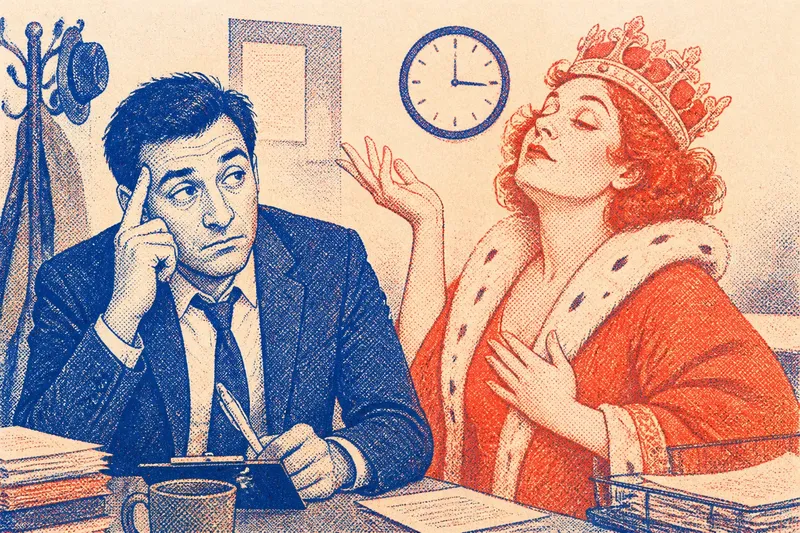
For instance, imagine a character who insists that a routine office handover should be conducted as a royal ceremony. Their colleague wants to leave on time, but is also pleased by any chance to be treated as an important court official. The colleague’s competing motives make the contrast playable: they resist the elaborate ritual, then help with one part because the role appeals to them. The expected effect is a relationship that shifts within the exchange, not a simple opposition between absurdity and good sense.
Why does the foil’s reaction change the joke?
A character’s behaviour can look different depending on who witnesses it. The same grand claim might meet open amazement, weary recognition or precise curiosity. Each response suggests a different history and gives the audience a different route into the scene.
Recognition is especially useful. A companion who has heard the eccentric character make similar claims before may respond with a familiar question rather than surprise. That reaction lets the audience infer an established pattern without a speech explaining it. It can also reveal affection: the foil knows the routine and still chooses to stay involved.
Surprise has its place, but constant shock quickly becomes generic. If every unusual action receives wide-eyed disbelief, the foil’s reactions stop distinguishing one event from another. A smaller response can be more informative when it identifies a precise consequence: the character notices that an important guest has arrived, that the plan has changed, or that the supposed solution creates a new problem.
How do you write the relationship without making one character a prop?
Let the foil affect what happens next. They can refuse a request, accept a bad idea for their own reasons, redirect a conversation or exploit the eccentric character’s confidence. These choices give them influence over the scene. If their only contribution is to ask questions that invite another character’s punchline, the role risks becoming a speaking cue rather than a person.
It also helps to give each character a kind of competence. The eccentric character may be inventive but poor at reading the room; the foil may be observant but overly concerned with appearances. Their strengths and limitations can collide. The foil is then neither the author’s voice of reason nor an obstacle placed in the way of fun.
When revising an exchange, look at what each person wants from it. If both want the same outcome, the contrast may come from their incompatible methods. If they want different outcomes, the scene can draw humour from negotiation. Either arrangement is more durable than making one character sensible in every context and the other foolish in every context.
Which questions help diagnose a comic foil?
Can the foil be funny in their own right?
They do not need to compete for the largest laugh, but they should have a recognisable comic sensibility. Their exacting manners, misplaced confidence or stubborn politeness can provide humour without copying the eccentric character’s style.
What does the foil want in this scene?
Name a concrete aim that would matter even without the joke: finish a conversation, protect a friendship or avoid embarrassment. That aim helps the character respond as a participant rather than an audience stand-in.
Does the reaction reveal a relationship?
A response can imply familiarity, rivalry, affection or exasperation. If any character could deliver the same line with the same effect, consider giving the foil a more personal reason to say it.
Is the contrast visible in behaviour?
Different priorities should lead to different choices, not just different descriptions. Let one character rush to improvise while the other asks for the missing detail, then allow each approach to affect the outcome.
What is not worth the effort?
It is usually not worth giving the foil a reaction to every comic beat. Constant sighing, eye-rolling or blunt correction can turn contrast into a repetitive signal, as if the scene needs to explain its own humour. Choose the moments when a response changes the meaning, raises the stakes or shows what the relationship has become. At other moments, the foil can simply pursue their own business.
The same restraint applies to making the eccentric character explain their oddness. A foil need not translate every impulse into a tidy diagnosis. A practical question, a withheld reply or an attempt to carry on with the task may show the gap between the characters more sharply.
Where does the strongest contrast come from?
It comes from two characters who interpret the same moment differently and have reasons for doing so. The eccentric character makes a choice; the foil answers from their own habits and interests. Their difference creates the comic shape, while their shared situation keeps them connected.
When considering a comic foil, look for the specific point of friction: a promise, a deadline, a social expectation or a desire for recognition. That point gives the contrast somewhere to land. The straight man can then be funny without abandoning their character, and the oddness can register without anyone having to announce that it is odd.