Straight Face or Broad Gesture? Two Comic Performance Registers
Straight face or broad gesture? Learn how restrained and exaggerated comic performance steer attention, shape a scene’s expectations and sharpen its payoff.

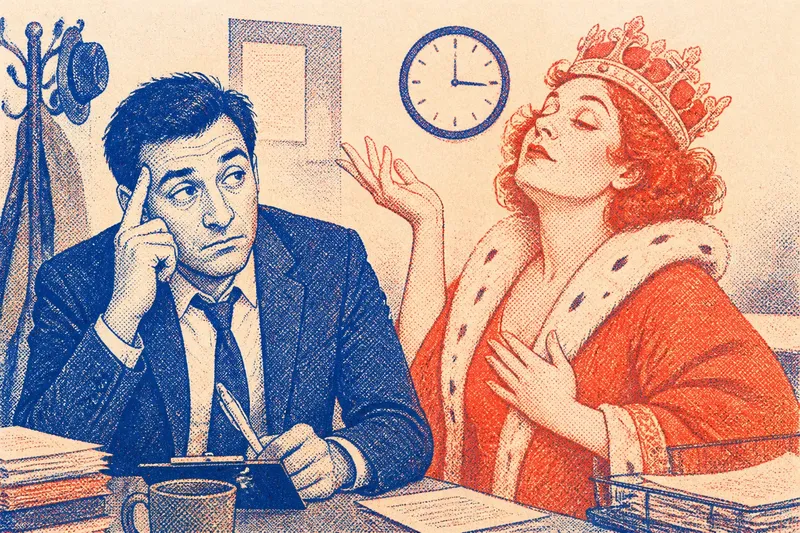
A straight face makes a comic scene feel as if its odd events are ordinary; a broad gesture announces that the oddness is the point. In comic performance, those two registers steer attention before a line has finished. The choice affects what an audience watches, what it expects next and how a scene’s payoff lands.
Imagine that a community hall’s caretaker, Mara, has been asked to introduce a prize-winning houseplant at a small ceremony. The plant is unexpectedly tall and leans towards the microphone. Mara has one cue card, a glass of water and no prepared remarks. This invented situation gives us a simple way to watch delivery change the scene without changing its basic events.
What does each performance register ask us to watch?
Restrained delivery keeps movement, expression and vocal emphasis close to everyday behaviour. Mara might glance at the leaning plant, pause, then continue reading the card in the same measured tone. The audience is invited to notice the mismatch: the ceremony treats the plant as a dignitary, while the plant appears to be trying to escape the microphone.
Broad delivery enlarges the performer’s signals. Mara might turn towards the plant with a ceremonial sweep of her arm, hold the card at full extension and project her next words as if addressing a packed theatre. The audience is now watching the performance of importance as much as the plant itself.
Neither register is simply “more comic”. Restraint can make a minor detail seem charged because the performer refuses to underline it. Broadness can make the same detail legible across a room, while inviting the audience to enjoy its scale. Each sets a different viewing task: look closely for the crack in the ordinary, or take in the spectacle of the joke.
How does restraint shape the imagined scene?
With a straight face, Mara’s calm manner gives the ceremony a stable surface. A small pause before “our guest of honour” may be enough to expose the absurd formality. The audience can infer that she has noticed the plant’s lean, or can simply enjoy the gap between the wording and what is visible. The performer does not have to explain the joke.
This approach depends on readable detail. A fleeting look should be directed clearly enough for the audience to catch, but not so emphatic that it becomes a separate punchline. Vocal control matters too: a sudden stress on “honour” may turn a quiet line into a pointed comment. A smooth delivery, by contrast, leaves more room for viewers to supply the irony themselves.
Restraint also creates a particular expectation. If Mara remains composed, viewers may expect the scene to continue as a proper ceremony, even as small disruptions accumulate. That expectation makes a later change of behaviour noticeable. If she suddenly addresses the plant in a solemn whisper, the shift itself becomes funny because the earlier control established a clear baseline.
What changes when the gesture becomes broad?
In a broad performance, Mara’s arm sweep, stance and vocal projection can turn the introduction into an event. The gesture gives the audience a clear visual cue: this moment is being presented as grand. The comic effect may come from the disproportion between that grandeur and the modest community-hall setting.
Broadness is not the same as random excess. A gesture needs a readable purpose. If Mara raises the card like a royal proclamation, viewers can connect the movement to the ceremony’s inflated tone. If she flaps her arms without a reason the scene supports, attention may scatter across the movement rather than gather around the plant or the announcement.
Scale also changes what the audience expects. An expansive delivery suggests that more display may follow: a grand introduction, a ceremonial pause or an elaborate attempt to keep the plant upright. The scene can then build through visible action. A small tilt of the head may be enough in a quiet performance; a large, deliberate turn may be needed to carry the same beat in a more physical one.
How can the same moment land differently?
Return to the moment when the plant leans towards the microphone. In a restrained version, Mara could shift the microphone a little, keep reading and leave a short silence before naming the plant. The audience’s attention moves from the official words to the small practical adjustment. The expected pleasure is recognition: the ceremony is pretending nothing unusual has happened.
In a broad version, Mara could step aside with an exaggerated flourish, presenting the plant’s lean as a deliberate bow. The audience is encouraged to read the movement as a staged event. The expected pleasure is visual: the performer has converted a modest wobble into a grand ceremonial gesture.
For the walk-through’s invented result, choose the restrained version because the scene’s interest is Mara’s attempt to preserve the formal tone. Her tiny microphone adjustment becomes the turning point, and the audience has time to register the contrast. If the purpose were instead to make the ceremony itself feel like an overproduced spectacle, the broad version would give the scene a clearer shape. The subject stays the same; the performance tells us where the joke lives.
How do you choose between straight face and broad gesture?
Begin with the attention you want to direct. Is the audience meant to notice an understated contradiction, a physical transformation, or the performer’s visible effort to make something ordinary seem grand? Then choose the register that makes that detail easiest to read. The following checks can help:
- Identify the comic focus. If a small discrepancy carries the joke, keep competing movement limited; if a physical action is central, give it room and shape.
- Set the scene’s baseline. Decide whether the surrounding behaviour is calm, ceremonious or already heightened, so a change in delivery has something to contrast with.
- Check the viewing distance. A face-led reaction may suit an intimate scene, while a large gesture may communicate more clearly across a wide stage or screen composition.
- Track the audience’s expectation. A controlled beginning can make a later burst feel surprising; an already expansive style prepares viewers for escalation.
- Remove unhelpful emphasis. Keep the glance, pause or flourish that directs attention, and cut actions that point at the same joke without adding a new beat.
There is no need to make every reaction expressive or to make every line sound perfectly flat. That extra polishing is not worth the effort if it draws attention away from the scene’s central detail. A performer can move between registers, but the change should have a reason the audience can sense.
What do viewers often want to know about comic delivery?
Can a straight face still show emotion?
Yes. Restraint limits how strongly emotion is displayed; it does not remove feeling. A brief hesitation or carefully held gaze can show discomfort, pride or surprise without turning the reaction into a large gesture.
Does broad comedy mean shouting?
No. Broadness can come from posture, timing, facial expression or a clearly shaped movement. Raising the voice is only one option, and it may obscure the joke if the scene depends on precise wording.
Can a scene shift from restrained to exaggerated?
It can, provided the shift changes the audience’s expectation for a reason. In Mara’s ceremony, a sudden grand flourish could signal that she has stopped trying to conceal the absurdity and is now performing it openly.
Which register works better on camera?
Neither is automatically better. A close view can make a quiet glance easy to read, while a wider composition may favour a gesture with a clear shape; the framing and the scene’s focus should guide the choice.
Straight face or broad gesture is not a contest between subtlety and skill. It is a decision about the audience’s attention. In Mara’s invented ceremony, the calm adjustment makes the plant’s intrusion feel quietly undeniable; the flourish makes it feel like a show. Notice which detail you want viewers to carry out of the scene, then let the performer’s scale point towards it.